Applications of AI/ML from Nuclear Data to Reactor Design

Applications of AI/ML from Nuclear Data to Reactor Design
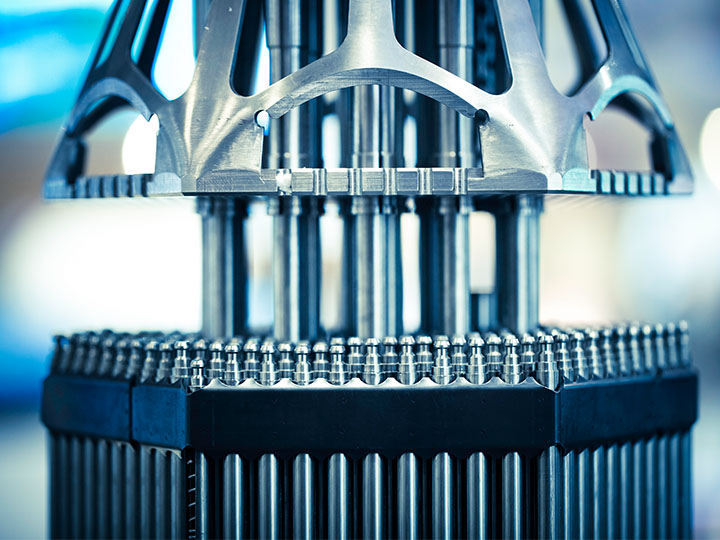
On February 8, Vladimir Sobes explored the applications of AI and ML in the field of nuclear engineering in a seminar hosted by the HPE Data Science Institute.

February 08, 2024 / Lena Pham


Nuclear reactor

Machine learning techniques are revolutionizing nuclear data evaluation and reactor design. Vladimir Sobes, assistant professor in the Department of Nuclear Engineering at the University of Tennessee, Knoxville, has dedicated his career to exploring the application of modern artificial intelligence and machine learning algorithms to current problems in nuclear engineering. 

In the realm of nuclear data evaluation, Sobes underscored the significance of ML algorithms in automating tasks such as hyper-parameter tuning and learning complex functions, particularly in the realm of uncertainty quantification. Sobes illustrated the structured nature of nuclear data, stressing the importance of automated feature identification—a task traditionally performed manually by experts. ML/AI, he argued, offers the promise of enhancing efficiency, reproducibility, and uncertainty quantification in nuclear data evaluation, thereby enabling experts to devote their time to more critical tasks. 

Transitioning to the topic of reactor design, AI has the potential surpass human capabilities in autonomous optimization, although Sobes cautioned against the indiscriminate use of surrogate models.  

Sobes demonstrated the effectiveness of the Gaussian Process Learning Algorithm for design optimization using a scenario related to the development of a spacecraft antenna. NASA engineers asked an AI algorithm to imagine an antenna. Despite an initial skepticism of its unintuitive design, rigorous testing demonstrated superior performance compared to human-designed alternatives. In 2006, the NASA ST5 spacecraft antenna, the same model proposed by an evolutionary computer design, was sent to space. 

AI/ML technologies are reshaping the landscape of nuclear engineering, from streamlining nuclear data evaluation processes to pushing the boundaries of reactor design beyond what was previously thought possible. Sobes' insights highlighted the symbiotic relationship between human expertise and AI, emphasizing the potential for collaboration to drive innovation in nuclear science. 

The presentation concluded with a quote by Arthur C. Clarke, adapted to signify the transformative potential of advanced optimization methodologies: "Any sufficiently advanced optimization methodology is going to be indistinguishable from intelligence."  

Sobes envisions a future where AI supplements human expertise, enabling breakthroughs in nuclear science and technology. 

Research Topics

Computational Approaches to Genetic Mechanisms in Disorders

Computational Approaches to Genetic Mechanisms in Disorders

On January 25, Kumaraswamy Naidu Chitrala presented his epigenome-wide association research on diseases and disorders, exploring the role of molecular mechanisms on health disparities through a computational approach.

January 30, 2024 / Isabelle Sitchon


Blue-tinted image with lightbulb to the right of a DNA helix

Health disparities— differences in health attributable to one’s social, racial, economic and/or environmental status— affect many nationwide. Efforts have been made in recent years to identify the root causes of these disparities. The lab of Kumaraswamy Naidu Chitrala takes this search to a molecular level, focusing on health disparities linked to aging, cancer, and neurological disorders while analyzing key genetic, proteomic, and epigenetic mechanisms using bioinformatics, computational biology, and statistical approaches.

In his talk for the HPE Data Science Institute, Chitrala first introduced his research concerning DNA methylation (DNAm), an epigenetic modification closely linked with aging and disease. Using samples collected from the Healthy Aging in Neighborhoods of Diversity Across the Life Span (HANDLS) study at the National Institutes of Health (NIH), Chitrala was able to analyze participants’ socioeconomic differences and their influence on DNA methylation and age-associated diseases, such as breast cancer, cardiovascular disease and metabolic syndrome.

In his analysis pipeline, Chitrala utilized computational tools like the Infinum MethylationEPIC BeadChip and the minfi R package to perform genome-wide DNA methylation analysis. With this, he built linear regression models to predict differences in methylation for the sample. Chitrala examined the significant results, which he used to conduct an epigenome wide association study (EWAS).

In the second half of the webinar, Chitrala touched on various other diseases and genomics-related studies within his lab, including research on PTSD, obesity, and proteomics. Some of his current lab efforts include creating a deep learning neural network to study breast cancer and metabolic syndrome genes, investigating candidate genes driving disparities among Triple Negative Breast Cancer (TNBC) patients using transcriptome association studies (TWAS), and RNA sequencing studies.


News Category

2023 Data Science Showcase

2023 Data Science Showcase

The HPE Data Science Institute and the Department of Computer Science hosted the second annual showcase of student research in data science fields.

January 18, 2024 / Isabelle Sitchon


Red-tinted image with a hand nearly holding an atomic formation with capitalize…

52 participants across 16 teams presented research in the fields of computing, data science and artificial intelligence at the annual Data Science Showcase hosted by the HPE Data Science Institute and the Department of Computer Science at UH. The event, held last December, was first launched in 2022 to provide a platform for highlighting the accomplishments of outstanding young researchers and encouraging them to pursue a future in data science. 

"This showcase allowed students to apply their knowledge and develop new skills through their research activities,” said Nouhad Rizk, Ph.D., instructional professor in the Department of Computer Science. “Many students enjoyed interacting with their mentors outside of the classroom, providing exceptional opportunities for them to learn and build lasting relationships."

The event featured presentations by UH students from various academic disciplines. Each group gave an overview of their abstract, background, results and more. Many research topics centered around applying AI techniques, such as neural networks, deep learning and machine learning models, toward real-life industry practices like disease detection systems and cybersecurity measures.

“We were excited to partner with Dr. Nouhad Rizk and the Department of Computer Science to support the Data Science Showcase for undergraduate students across UH,” said Andrew Kapral, Ph.D., Director of Engaged Data Science at the HPE DSI. “From classifying geologic formations in the Athabasca Oil Sands to predictive analysis of outcomes for patients with heart disease, the projects presented this year covered a broad range of topics and were of outstanding quality.”

The showcase offered students the opportunity to educate themselves on communicating their research, while also providing them a channel of peer support for a future in data science. 

“Project-based learning is essential for honing data science skills, and we look forward to expanding opportunities for UH students to engage in these kinds of experiences in future,” Kapral said.

At the end of the event, a jury voted on the best student projects. The panel consisted of faculty and staff from the Department of Computer Science and the HPE Data Science Institute. Each winning group received an Amazon gift card. 

Showcase Winners 

First Place

Team: William Le, Ruben Daniel Montemayor, Charlies Tian
Project: Heart Disease Prediction Using Deep Learning

Second Place

Team: William Brieden, Khanh Nguyen, Osasenaga Obano
Project: Diabetic Retinopathy Classification Using Neural Networks

Third Place

Team: Wian van Dyk, Joshua Folh, Sammy Hamdi
Project: Brain Tumor Classification in MRI With Deep Learning

Fourth Place

Team: Jusvin Charles, James Graham, Justin Hose
Project: Retinal Disease Detection Using Convolutional Neural Networks

Fifth Place

Team: Nirorn Hong, Maximus Furtado, Erik Perales
Project: Age and Gender Prediction Using Convolutional Neural Networks


News Category

Preparing the AI Workforce

Preparing the AI Workforce

On March 1, the HPE Data Science Institute and University Career Services will host the first-ever AI Industry Symposium and Career Mixer at the University of Houston.

February 26, 2024 / Isabelle Sitchon


AI Symposium Background Image

The HPE Data Science Institute has partnered with University Career Services for a day of discovery and opportunity at the inaugural Artificial Intelligence (AI) Industry Symposium and Career Mixer. The event is open to students, alumni, faculty and staff from UH as well as industry professionals in the Houston area.
 

The event, sponsored by Chevron, addresses the emergent need for practical discussion on AI across industries and on preparing students to join this evolving workforce. Attendees will have the chance to connect with industry professionals and gain insights on how to thrive in increasing AI-enhanced environments. Panelists will include representatives from Chevron, ConocoPhillips, Hewlett Packard Enterprise, Humana, Metegrity, Patterson-UTI, and Shell.
 

After the symposium, students will be able to meet face-to-face with companies at the career mixer.
 

Claudia Neuhauser, director of the HPE DSI, describes the event as “a necessary and timely collaboration” between the institute and University Career Services. “As AI becomes established and integrated into corporate environments, we are finding ways to bridge academic training to meet these professional opportunities.”
 

The AI Industry Symposium and Career Mixer will be held on Friday, March 1 in the Houston Room of UH Student Center South. Attendees may register for the full event or individual sessions here. Recruiting employers can register to engage with UH students at the career mixer here. This event is free for all attendees thanks to event sponsor Chevron.

For more information, please visit the event website.