Showcase Prepares University of Houston Students to Lead in an AI-driven Economy
Showcase Prepares University of Houston Students to Lead in an AI-driven Economy

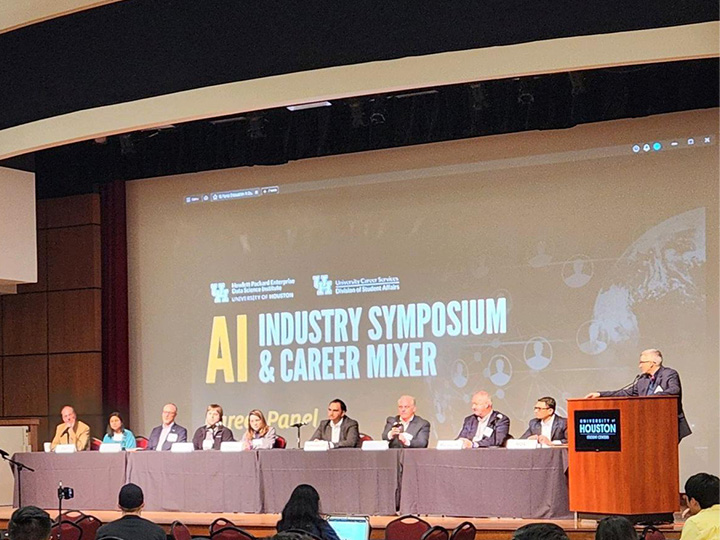
The University of Houston’s AI and Data Science Showcase brought together 31 student teams on May 6 to demonstrate how artificial intelligence and advanced analytics can solve real-world challenges.
The twice-yearly event recognizes student researchers committed to the fields of computing and data science. It serves as a cornerstone of the University’s mission to graduate leaders who are ready to navigate a workforce being rapidly reshaped by AI.
Professor Nouhad Rizk, director of undergraduate studies in computer science, launched the event in 2022 as a capstone project. Since then, it has evolved into a university-wide platform that prepares students from all disciplines for the modern economy.
“Artificial intelligence is not going to replace us, but it is going to provide new horizons and opportunities,” Rizk said. “It depends on how much you are willing to put in or how curious you are. If you are curious, you can do great things with this technology.”
Developing the Algorithm
Undergraduate and graduate students selected public datasets aligned with their interests, ranging from sports statistics and crime trends to public health. Historically, a significant number of projects focus on healthcare imaging, such as using AI to predict the stage or aggressiveness of brain and lung cancer.
To participate, teams must define a clear objective, then develop advanced algorithms to scour datasets and interpret the results. The event moves students beyond simple coding assignments, requiring them to also write professional research papers and present findings to a panel of judges.
This year’s winning team — senior computer science students Cameron Rojas, Long Tran and Erick Becerril — developed an algorithm for kinship verification. By analyzing photos of famous individuals and their children, the team achieved an 80% accuracy rate in parent-child identification when photos were taken in similar settings.
“When you reduce variation for the images, it improves the model without even changing the architecture itself,” Rojas said.
Tran said the project underscored the importance of data engineering.
“We could make our custom model stronger by adjusting parameters, but we definitely need longer training time,” Tran said. “Given more time, I think we could reach the parameter that we’re wanting.”
Connecting to the Bigger Picture
The showcase is in collaboration with UH’s Hewlett Packard Enterprise Data Science Institute, which provides critical computational resources.
“These showcases are great opportunities for students to present their research,” said Claudia Neuhauser, UH’s vice president/vice chancellor for research and director of the HPE Data Science Institute. “We always look forward to engaging with them and learning how they use AI in their research projects.”
The event is part of a broader, university-wide effort to ensure every graduate develops the fluency to use AI thoughtfully, ethically and strategically. To ensure Cougars are prepared to lead in the AI-era, the University offers more than 140 courses and flexible learning pathways in artificial intelligence, from foundational courses to advanced degrees and professional programs across 14 different colleges, ensuring AI education is woven throughout the academic experience.
“Our goal is to ensure that our graduates are fully prepared to succeed professionally and become meaningfully integrated into the Houston workforce and broader community. By strengthening participation, community-building and program accessibility, we can better position our students for long-term success in the region’s top employment environments.”
—Nouhad Rizk, director of undergraduate studies in computer science
This commitment to AI literacy is also reflected in new academic milestones, including the upcoming fall launch of two related degree programs: a Ph.D. in Statistics and Data Science and a M.S. in Computer Science – Artificial Intelligence at the UH Katy Campus.
Looking ahead, Rizk aims to further align the showcase with the Houston economy — specifically the Texas Medical Center. By inviting doctors and researchers from MD Anderson Cancer Center, Houston Methodist Hospital and UH’s Tilman J. Fertitta Family College of Medicine to guest lecture and co-advise projects, UH is building a direct bridge to local internships and full-time careers.
“Our goal is to ensure that our graduates are fully prepared to succeed professionally and become meaningfully integrated into the Houston workforce and broader community,” Rizk said. “By strengthening participation, community-building and program accessibility, we can better position our students for long-term success in the region’s top employment environments.”